Fashion
Pants Outseam Measurement: Label the Outside Length
An outside-leg number needs endpoints and a method, not an inferred size.
Outseam describes an outside trouser length. For a garment method that includes the waistband, measure from its top edge down the stated outside route to the finished hem. Keep the trousers relaxed and record the units and cuff state. Confirm the seller's method before comparing; an unlabeled length is not enough.
Find the outside route first
Outseam belongs to the outside of the trouser leg. Inseam starts at the inner-leg crotch junction, so the two names should not be exchanged. A listing that says only length may mean either of these, or a different convention. Ask for the endpoints before comparing it with a garment at home.
This guide concerns a finished garment laid flat. A body measurement taken while someone stands is a different record. Do not substitute one simply because both use the word outseam. State which kind you have and keep the original label with the value.
Use a named garment method
Luxire's pants measurement guide describes an outside route from the top of the waistband to the lower leg edge along the side seam. Use that convention when comparing with a record made by that method. Another seller's sheet may specify a different setup, so read its instructions first.
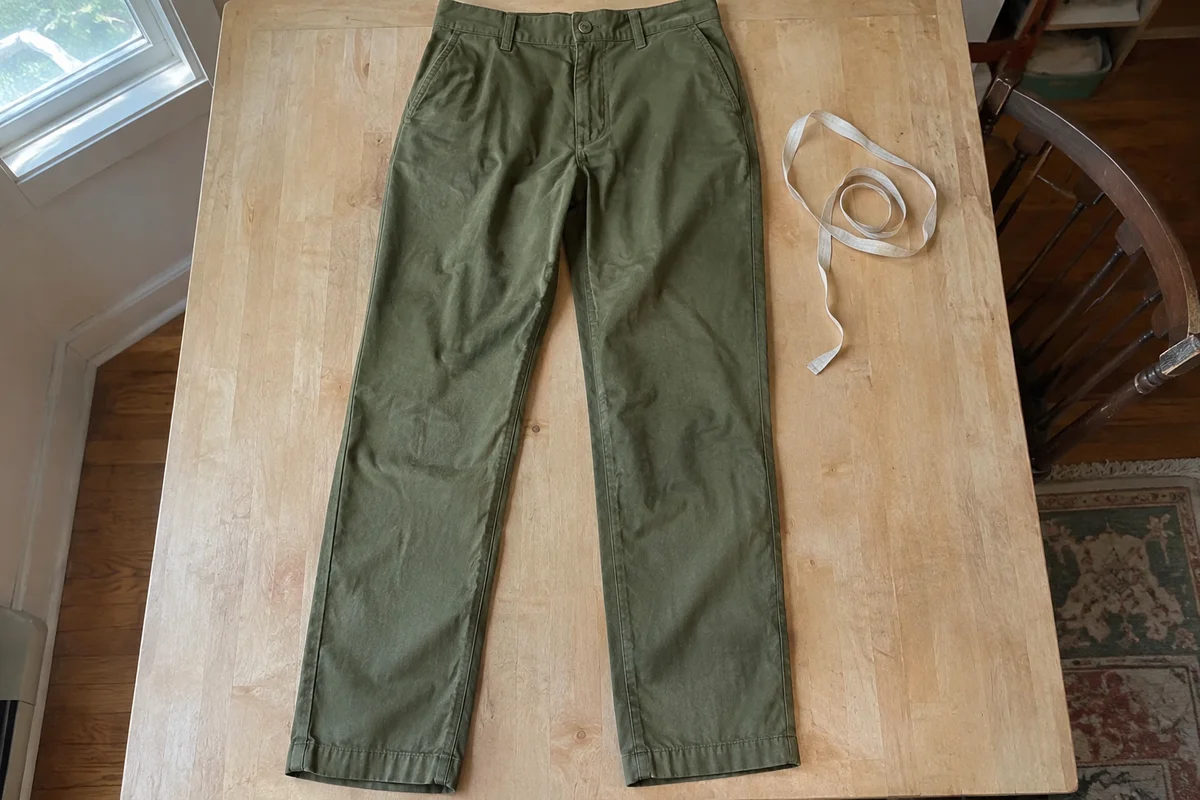
Put the trousers on a surface that supports their full length. Empty the pockets, settle the garment without pulling it longer, and identify the upper edge and finished lower edge. Use a flexible tape in the stated direction. Keep the tape against the intended route rather than letting it wander across the front panel. If the side seam is unclear or the construction differs, request clarification instead of inventing a line.
The Alexanders of London garment guide explicitly includes the waistband in its outseam definition. Its general preparation instructions also call for relaxed clothing. Those details belong in the record; they are not evidence that every unlabelled seller uses the same convention.
| Field | Record it explicitly |
|---|---|
| Object | Finished garment, not a standing body measurement |
| Upper endpoint | Named waistband edge; inclusion confirmed |
| Lower endpoint | Finished hem or the specified cuff edge |
| Route | Outside seam or the seller's stated line |
| State | Relaxed, cuffs as described, no pulling |
| Units | Inches or centimeters, retained with the reading |
Keep cuffs and unfinished hems visible in the note
A turn-up changes which edge you might be looking at. Record whether it is a permanent cuff or a temporary fold and ask which edge the method requires. Do not unfold a finished cuff and present that reading as the current wearable length. If trousers are sold unfinished, identify that state before comparing with a hemmed reference pair.
For an unfamiliar split hem, asymmetric edge or adjustable lower opening, leave the endpoint unresolved until the seller identifies it. A clean number obtained from the wrong corner is still the wrong comparison. Our leg-opening guide covers width across the hem; it does not define the vertical endpoint for every construction.
Listing comparison checklist
Check each detail you have confirmed. These ticks stay on this page.
Do not calculate the missing dimensions
Keep outseam, inseam and rise as separate fields. Do not treat a subtraction as a replacement for a directly measured value. Their routes and endpoints differ, and a rise is not simply an extra straight length attached to the inseam.
Likewise, a matched outseam does not guarantee matched fit. Waist placement, shaping, fabric and leg width affect how a pair wears. Compare the other fields with a relevant reference pair and retain any missing information as a question. Never turn the outside length into a promised clothing size.
Finish with a practical comparison
Measure a reference pair you actually wear, using the listing's method. Keep its hem state and intended shoes in the note. If you can try the new trousers, check normal standing, sitting and walking under the retailer's fitting conditions. A measurement helps describe the garment; it does not replace wearing it.
If the comparison still leaves a length concern, ask about that garment's alteration options and return conditions before buying. A seller's answer about one unfinished pair cannot establish what can be changed on another finished pair.
Questions about outside length
Does outseam include the waistband?
The two named garment guides above include it. Confirm the convention for any other record rather than assuming.
Can I infer inseam from outseam?
Do not replace a direct inseam reading with a calculation. Keep the separately named routes and endpoints.
Is a folded cuff the same as the full leg length?
No. Describe the cuff state and identify the edge used in the reading before comparing values.