Fashion
How to Build a Capsule Wardrobe in Five Steps
Fewer pieces, better chosen, and every one of them works with at least three others.
A capsule wardrobe is a small set of versatile pieces that combine into many outfits. Build it in five steps: audit what you own, define how you actually live, fill the core categories, choose a colour base and test each outfit before you buy anything.
What a capsule wardrobe actually is
A capsule wardrobe is a deliberately small collection of clothes that suit your daily life and mix easily. It is not a challenge with a fixed number of items, and it is not a uniform. The useful question is simpler: can each piece be worn with at least three others you already own?
Most closets fail that test for a predictable reason. Clothes are bought for one occasion, one mood or one shop window, and then they sit. A capsule approach reverses the order. You decide what your weeks require, then you buy only what fills a real gap.
Step 1: Audit what you already own
Take everything out of the wardrobe that you have not worn in the last twelve months, and put it in one place. Do not decide yet what to keep. Instead, sort the rest into three piles: pieces you reach for, pieces you wear only sometimes, and pieces that do not fit well or never feel right.
The middle pile is the most useful. It tells you whether a piece is wrong or whether it only needs a shoe change, a tailor or a different top. Many people discover that their best-fitting trousers are not in regular rotation because the shoes they need are missing.
- Keep the reach-for pile in the front of the wardrobe.
- Mark the sometimes pile with a tailor or a shoe note.
- Set aside the misfits for resale, donation or repair within a month.
Step 2: Define how you actually live
Write down a typical week in plain terms: office days, errands, weekends, one or two events. A capsule built for a life you do not live will sit unused. Be specific. "Smart casual" means little until you list the actual rooms you walk into.
A useful test is to count the occasions in a normal month and mark which ones need a structured layer, which need comfort and which need a little colour. Your final list should reflect that mix, not your most ambitious weekend.
Step 3: Fill the core categories
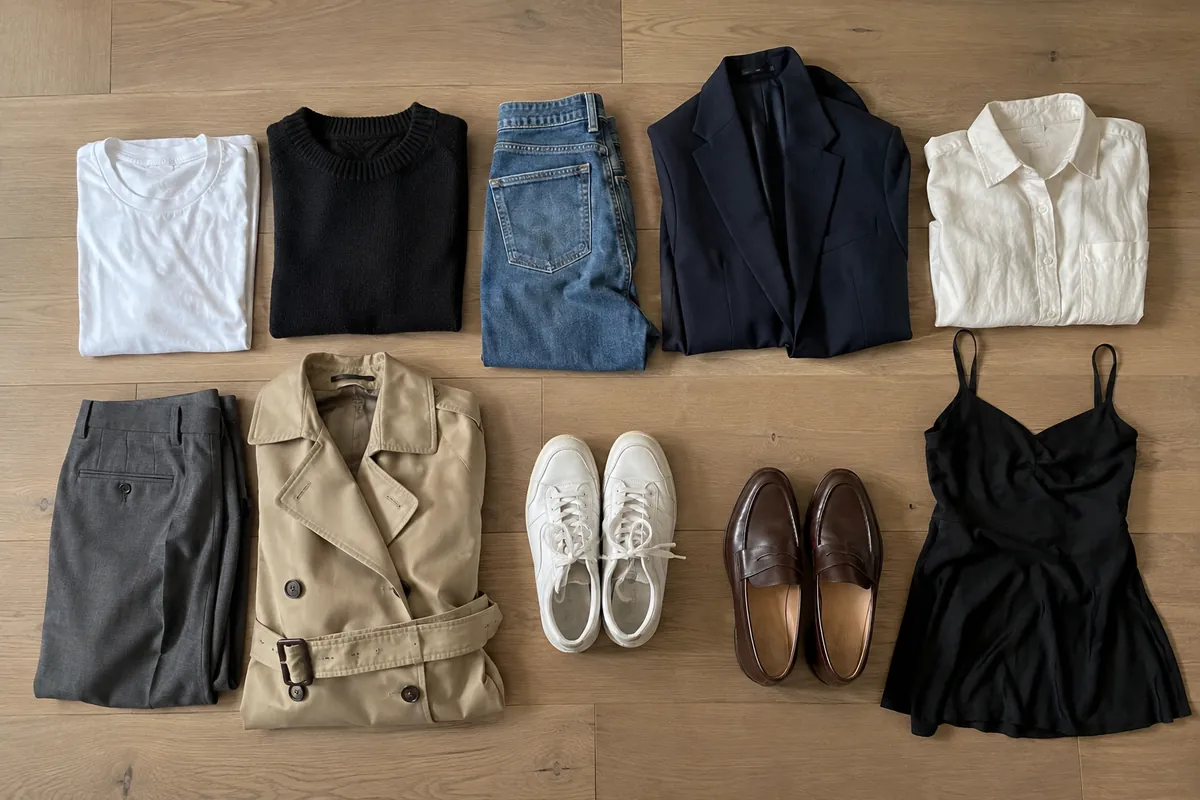
Most functional capsules rest on nine core categories. You do not need a large number of each. You need at least one good version of each, plus one or two extras where your week demands them.
| Category | What to look for | Typical count |
|---|---|---|
| Tops and tees | Good neckline, fabric that does not go sheer | 4 to 6 |
| Knitwear | Fine gauge in a neutral colour | 2 to 3 |
| Trousers or jeans | A cut that suits your shape and sits well | 2 to 3 |
| Skirts or dresses | One for work, one for evenings | 2 to 3 |
| Blazer or structured layer | Shoulders that fit without alteration | 1 to 2 |
| Coat or trench | Warm enough for your winter and easy to wear | 1 |
| Everyday shoes | Comfortable for the longest day you have | 1 to 2 |
| Smart shoes or boots | Matches your most formal occasions | 1 |
| One everyday bag | Fits your daily load and goes with everything | 1 |
Use the checker below to see which categories you already cover. Be strict with yourself: a tee that you only wear at home does not count for daily use.
Capsule check
Tick what you already own in good condition. Nothing is sent anywhere.
Step 4: Choose a colour base
A capsule works best when most pieces share a base. Pick three to four neutrals, such as navy, grey, camel and white, or black, oatmeal and denim blue. Add one accent colour that you wear often and that suits your skin tone.
Limit the palette on purpose. When a tee in one shade of grey clashes with a knit in another, the outfit looks accidental even when every piece is good. Matching the base colours prevents that problem before you shop.
Step 5: Test before you buy
Before a purchase, build three outfits with the piece and your existing clothes. Wear each outfit in your head across a real day: the commute, a meeting, dinner. If any of the three fails, the piece is not yet a good fit for your capsule.
Keep a running list of gaps rather than buying on impulse. A gap might be a warm layer for cold mornings or a shoe that works with trousers. Fill one gap at a time and you will end up with a wardrobe that works without much effort.
How many pieces is enough?
There is no correct number. Some people are happy with thirty pieces, others with fifty, depending on climate, job and how often they dress up. The useful measure is whether you can get dressed for every planned day without repeating the same outfit within a week, and without buying something to solve a problem you can avoid.
If you want a starting point, aim for a base of around thirty items excluding underwear, sleepwear, activewear and outerwear used only for heavy weather. Then review it each season. A capsule is a living list, not a one-time purchase.
A worked example: a seven-piece base
Take a woman who works three days in an office, spends one evening a week at a restaurant and walks a lot at weekends. Her audit finds twelve tops she likes, but only two that are free of stains, pilling or wrong fit. She owns two pairs of trousers and no real coat.
Her plan has three steps. First, she keeps the two good tops and sends the rest to be repaired or resold. Second, she buys a navy blazer and a camel trench, since those two pieces cover work, evenings and weekends. Third, she adds one pair of dark straight jeans and one pair of loafers that suit both. Her base is now seven pieces plus the shirts and knits she already owned.
Within a month, she can name three outfits for each piece. That is the test. If she could only name one outfit for the blazer, she would look for a different item, not a second blazer.
Frequently asked questions
Is a capsule wardrobe only for minimalists?
No. A capsule is about how well your clothes work together. Someone who loves colour and print can build a capsule too, by limiting the neutrals and choosing a few statement pieces that all pair with the same base.
Should I replace everything at once?
Almost never. Start with the gaps that cause the most daily friction, such as a coat that is too thin or shoes that hurt after an hour. Replace the rest as items wear out.
What if my job requires a uniform?
Treat the required items as fixed and build the capsule around them. Choose one or two pieces for your own time, and make sure they coordinate with the uniform colours.
How often should I review it?
Twice a year, at the change of season. Keep the pieces you wore, mark the ones you did not, and decide whether a gap is real before you shop.
Keep building
Read how to measure whether a purchase is worth it before you buy anything for the capsule, and use the thrift checklist if you plan to fill gaps secondhand.