Fashion
Pants Leg Opening Measurement: Record the Flat Hem Width
Name the opening, its state and the units before comparing the number.
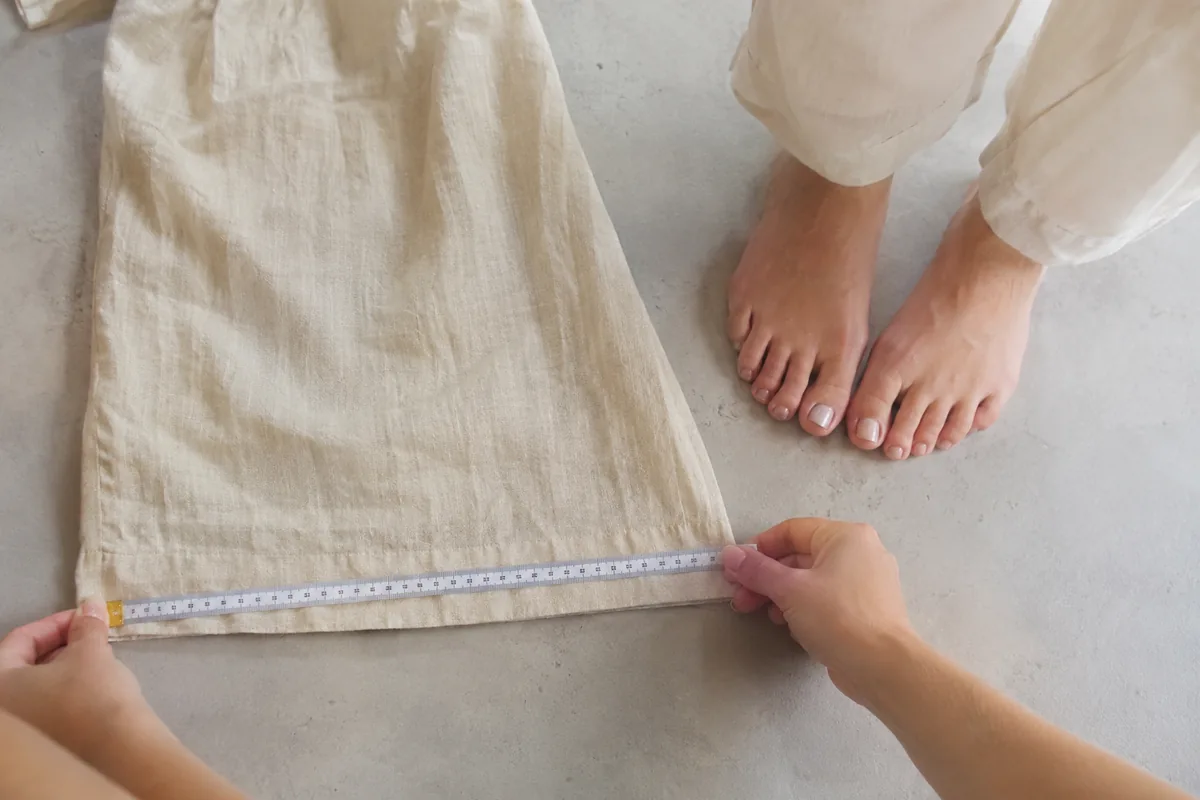
For a flat leg-opening measurement, lay the trousers in the maker's stated position, smooth the lower leg without stretching and measure straight across the hem from one edge to the other. Record the units, leg and cuff or elastic state. Compare another pair with the same method; a flat width is not a body measurement.
Identify the opening at the bottom of the leg
The leg opening is the opening at the trouser hem. A flat width runs across it from one edge to the other, rather than down the leg. Keep that field separate from inseam length, knee width and any circumference listed by a seller. An unlabeled number called bottom or cuff needs clarification before it becomes a comparison.
Use the current finished garment as the reference unless the maker asks for another state. A permanent turn-up, elastic cuff, drawcord or side opening can make the edge less straightforward than a plain hem. Describe what you have instead of flattening or unfolding the garment until it resembles a different construction.
| Record | What to state |
|---|---|
| Span | Across the named hem opening |
| State | Relaxed, folded as worn, or another specified setup |
| Side | Left or right leg |
| Units | Original inches or centimeters |
Follow a named maker's setup
Proper Cloth's leg-opening guide lays trousers on their side along the creases, moves the upper leg away and measures across the lower hem. Drinkwater's Cambridge likewise describes an edge-to-edge reading at the bottom of the leg. These provide clear methods for their garment measurements.
Luxire's trouser guide also specifies a measurement across the pant hem. When using a seller's number, reproduce that seller's method on your reference pair. Do not assume that a listing with a different or missing diagram uses the same convention merely because its field has a familiar name.
Support the hem without pulling it wider
Place the trousers on a firm surface and let the relevant lower leg lie flat. Smooth ordinary wrinkles gently, preserving the specified crease layout where applicable. Lay the tape straight across the defined opening. Do not angle it upward into the wider leg or use the visible stitching line as an endpoint unless that is what the instructions request.
Reset the fabric and repeat the reading. If it changes, check the layout and tape position before rounding the difference away. For an uneven or unfamiliar hem, a photograph showing the intended span may be more useful than a more precise-looking decimal. Label another leg separately rather than combining two readings without explanation.
Keep a cuff or elastic edge explicit
A turn-up folded as worn and a temporary roll are not interchangeable states. Record which edge you measured and whether the cuff was left intact. Do not unpick a permanent cuff to obtain another number for a casual comparison. Ask the maker which state its specification expects.
For elastic or an adjustable opening, a relaxed width and a stretched width describe different setups. Do not stretch it to an arbitrary limit and call the result its size. Request the stated measuring method, including how an adjustment is set. If that remains unknown, keep the comparison pending rather than guessing a conversion.
A flat width does not select the whole fit
Some charts report an opening circumference instead of a flat width. Keep the original labels and ask how the number was obtained before doing arithmetic. Neither field is an ankle measurement or a guarantee that the trousers will pass comfortably over your preferred shoes.
Our knee-width guide concerns another location down the leg, while inseam measurement records length. Consider those dimensions, fabric and intended silhouette together. A matching opening alone does not establish that two pairs have the same shape or feel the same in use.
Listing comparison checklist
Check each detail you have confirmed. These ticks stay on this page.
Compare the pair with the outfit you intend to wear
Choose a reference pair you actually enjoy wearing with the relevant shoes. Measure it using the same setup as the listing, and retain its length and hem state alongside the width. A narrow opening on a cropped pair and the same opening on a longer pair can create different outfit questions.
If you can try the trousers on, assess ordinary walking and sitting under the retailer's fitting conditions. If you cannot, ask one specific question about the missing field and check the actual return terms. Our small fashion-risk guide helps keep an unfamiliar silhouette a considered experiment rather than a guessed fit promise.
Questions about the hem width
Is leg opening the same as inseam?
No. Leg-opening width goes across the bottom; the inseam is a separate inside-leg length.
Should I double every opening measurement?
No. First identify whether the seller reports flat width or circumference and how it was measured. Preserve that original label.
Can one opening width predict how pants sit over boots?
No. Length, shape, fabric and the actual boots matter too. Use a relevant reference pair and a complete outfit check where possible.